☽
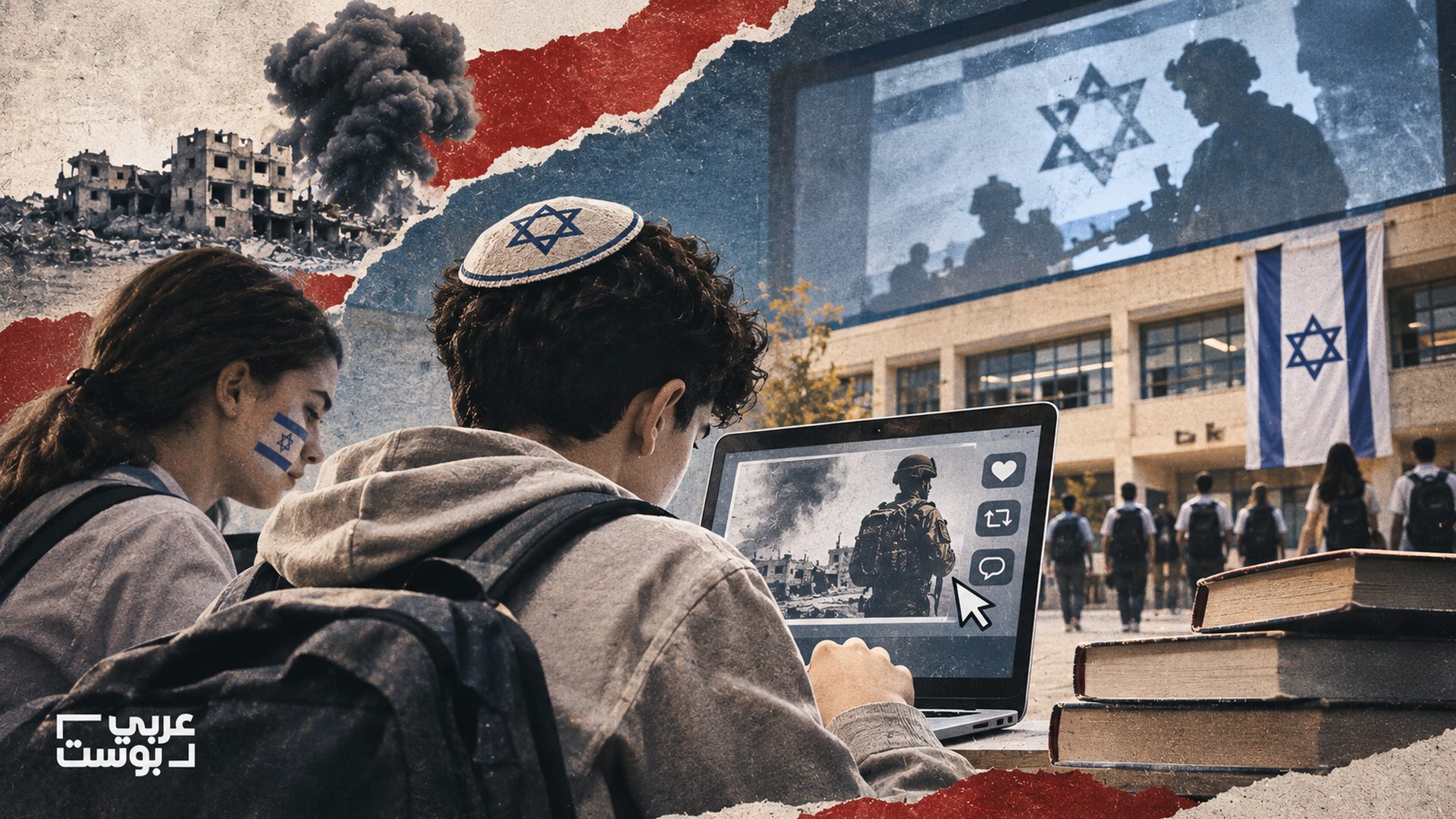
Raising a Generation for WarHow Israel’s schools changed after October 2023: students recruited for propaganda, classrooms militarized, settlements glorified
Investigation: Murad Mohammad Al‑Hamwi and Ahmed Ibrahim
Investigation: Murad Mohammad Al‑Hamwi and Ahmed Ibrahim
Arabic Post investigated how the events of October 7, 2023, and the war that followed affected Israel’s education system, documenting significant changes to curricula and school activities that reinforced the Israeli government’s official narrative of the war and expanded the military dimension of certain aspects of education. These changes went as far as involving school students in government-supervised propaganda campaigns targeting audiences abroad.
Israel has long monitored curricula and educational practices in Arab countries. This time, however, Arabic Post reversed the direction of scrutiny, examining what took place inside Israeli schools after October 2023 and revealing how the Ministry of Education’s accounts of the war differed depending on whether they were presented to Arab, Druze, secular Jewish, or religious Jewish students.
The investigation also documented how these changes extended to expanding requirements for teaching Jewish and Zionist identity, modifying examinations, and tightening scrutiny of teachers and their positions on the war.
The investigation drew on a review of dozens of Israeli documents, including government decisions, legislation, Knesset proceedings, curricula, textbooks, educational plans, examination papers, and materials issued by the Ministry of Education and government and religious institutions, as well as reports by oversight bodies.
To establish what had changed, Arabic Post compared educational materials from before and after October 2023 and traced how the programs were implemented and funded, the extent to which they were mandatory, and how widely they had been adopted across schools.
How the Ministry of Education Recruited School Students to Promote Israel’s War Narrative
Back to chaptersThe investigation’s findings show that one of the most notable changes in Israel’s education system after October 2023 was the transformation of the use of school students, including minors, in official Israeli propaganda into an organized government project.
In the second half of October 2023, as Israeli warplanes bombarded Gaza, Israel’s Ministry of Education opened another front, recruiting school students to take part. It launched a project called “NOVA,” a Hebrew acronym for “Youth on the Frontlines of Hasbara and Influence.” “Hasbara” is the term Israel uses to describe its propaganda efforts aimed at international public opinion, intended to explain and defend its policies.
Arabic Post examined details of the project published on the Ministry of Education’s official website, which reveal that its objective went beyond simply educating students about the war. It sought to involve them in shaping public opinion outside Israel. The ministry states that “Israel must obtain international legitimacy for the military campaign we were forced to enter,” and that young people are capable of “driving change in global awareness and discourse.”
The project was implemented in partnership with the Ministry of Diaspora Affairs and Combating Antisemitism, the Ministry of Foreign Affairs, the Gesher organization, and the Meir Center for Diplomacy. To achieve its objectives, it recruited student volunteers from grades 9 through 12 who were proficient in a foreign language and committed to working “at least one hour a day.”
The students’ tasks included systematically engaging with content circulating on social media by liking and sharing pro-Israel posts to amplify their reach, monitoring and reporting content hostile to Israel, and publishing propaganda materials overseen by the organizations running the project, which were distributed to their groups twice daily.
The “NOVA” project page on the Israeli Ministry of Education portal
Published figures reveal how rapidly the project expanded during its first few months. Around 800 young people, teachers, and parents received training related to the initiative, while more than 1,500 young people had joined by November 2023. In January 2024, Education Minister Yoav Kisch announced that the project had “undoubtedly succeeded,” with approximately 2,500 young volunteers participating. By that point, they had published 211 images, 82 videos, 278 links, and 71 documents.
NOVA project
Figures announced by the project’s organizers since its launch in the second half of October 2023
Arabic Post’s investigation into the details of the NOVA project led to the discovery of an official project presentation outlining its activities. The presentation referred to a group of approximately 3,000 male and female students, whose published materials were subject to monitoring by the Ministry of Education and its partners.
Cover of the official “NOVA” presentation: “Youth on the Frontlines of Hasbara”
From the official presentation: a group of about 3,000 students
A training presentation published on the Israeli Ministry of Education’s website about the NOVA project reveals some of the instructions students receive and the methods they are expected to use to influence discussions surrounding the war.
The presentation makes the project’s political objective explicit, stating that when Israel “is at war, it must work to secure international legitimacy, first and foremost from the United States and Europe, for the use of force.” Alongside this statement, the presentation features an image of a demonstration with a placard reading, “Stop the genocide, Free Palestine.”
From the official presentation: Israel needs “international legitimacy for the use of force”
The project presentation also includes instructions teaching students how to handle posts critical of Israel, with rules specifying when to respond and when to simply report them. According to the guidelines, a negative post that has received fewer than 100 likes “should not be responded to, only reported.” If it exceeds that threshold, students are instructed to respond to it and then report it.
The training also covers what students should say in their responses, providing guidelines for countering accusations against Israel by matching certain terms with others. When confronted with “racism,” students are instructed to respond with “democracy”; with “occupation,” they should respond with “security”; and with “excessive force,” they should respond with “human rights.” These instructions appear in slides titled “Tips We Received” from a representative of the pro-Israel American organization StandWithUs.
“StandWithUs” tips for students: answer “racism” with “democracy”
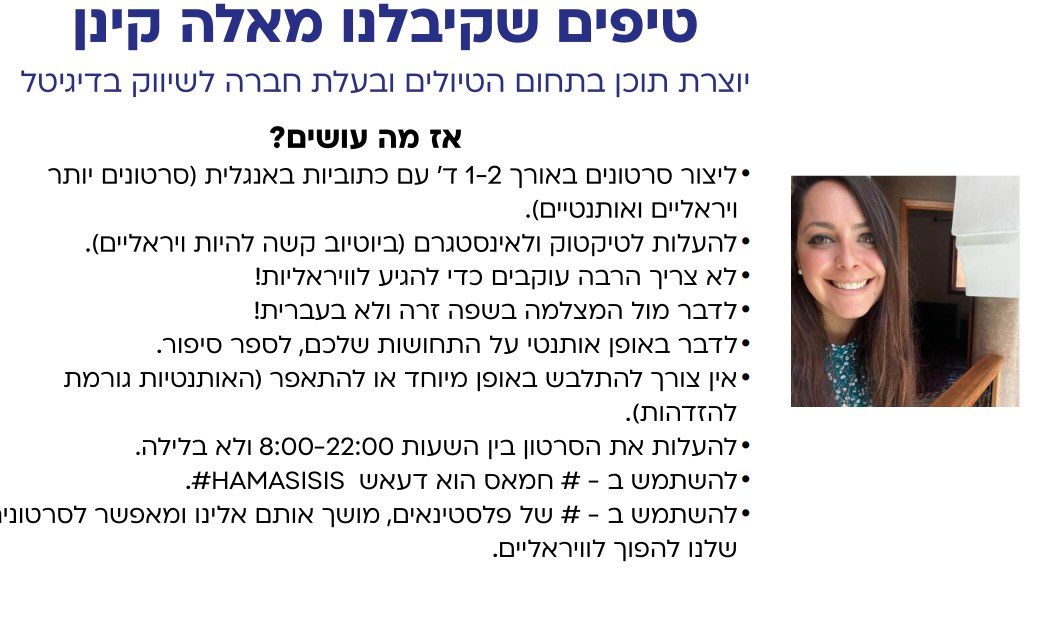

Among the figures whose advice was featured in the presentation was Ella Kenan, whose activities Arabic Post previously investigated in an investigative report. A former officer in Israeli military intelligence who was discharged from the army with the rank of captain, Kenan leads extensive projects aimed at laundering Israel’s reputation online.
Yet the presentation introduced her to students in a different capacity: “Travel content creator and owner of a digital marketing company.”
Kenan advises students to use the hashtag “Hamas is ISIS”, which she says she launched in the early days of the war.
She also encourages them to use hashtags posted by Palestinians themselves, explaining that doing so “draws them to us and allows our videos to go viral.”
These instructions were not merely theoretical advice. In the same official presentation, Arabic Post found an example of a video produced by a student at Rabin High School in the city of Kfar Saba, titled “Does a Higher Number of Casualties Determine Who the Victim Is?”
From NOVA’s official presentation: a video by a student at Rabin High School in Kfar Saba, “Does a Higher Number of Casualties Determine Who the Victim Is?”
By tracing the student’s activities, we located an interview broadcast by Israel’s Channel 13 during the first weeks of the war, which the Ministry of Education subsequently republished on the project’s webpage. According to the student, he was about to turn 16 at the time.
The channel aired a video he had produced, opening with the question: “Have you ever stopped to ask why Gaza keeps running out of water, electricity, food, and medicine, but never runs out of rockets, weapons, and ammunition?” The phrase “Hamas is ISIS” then appeared in large letters—the very slogan Kenan had recommended that students use in the training presentation.
The interview also revealed another aspect of how the project was presented to the public. According to the student, “one of the first things they explained to us” was that the project “is not a government organization,” because “young people tend to sympathize more with freedom fighters than with the state.”
The campaign to recruit participants for NOVA was not limited to the Ministry of Education; it also extended to Israeli school networks. On December 4, 2023, the Amal school network published an invitation to its students titled “Amal Students? Enlist in Hasbara!”, encouraging them to participate in a free online webinar titled “50 Seconds on TikTok: The Hasbara Battle.” The webinar was presented by Evyatar Edri, whom the network described as “an expert in artificial intelligence for hasbara.”
The “Amal” network’s invitation to its students: “Enlist for hasbara!” (machine translation from Hebrew)
The webinar’s advertised topics reveal the types of skills the school network sought to teach students, including “creating viral content using artificial intelligence,” “using opponents’ social media platforms against them,” and “groups for reporting and removing anti-Israel content.”
The invitation then moves from training to active participation, posing the question, “What do you do next?” and answering, “Enlist in NOVA,” under the heading “NOVA Headquarters: A Call to Enlist for Students!”
During the 2024–2025 academic year, the Ministry of Education expanded NOVA to include a program within schools and invited secondary schools to join the initiative.
Under the program, teachers and students receive training from “leading hasbara experts, influencers, and media professionals.” A content creation team is established to meet weekly, with its videos published on the project’s Instagram and TikTok accounts, alongside a nationwide WhatsApp channel.
The ministry’s invitation to high schools to join the “NOVA” program, 2024–2025
The official “operating model” outlines students’ responsibilities, including responding to posts in real time, amplifying pro-Israel content, and reporting posts hostile to Israel. The program operates at three levels—school, educational district, and national—in cooperation with the educational district’s media spokesperson.
Notably, these propaganda activities are no longer simply voluntary work conducted outside the school system. The ministry’s model requires teachers to monitor students’ activities so they can be credited toward the “Community Involvement Program,” which requires secondary school students to complete volunteer hours to obtain their graduation certificates.
The official “operating model” of the “NOVA” program in schools
Session of the Knesset Immigration, Absorption and Diaspora Affairs Committee, July 2, 2024
From the minutes: TikTok removed a ministry campaign within 24 hours
From the minutes: “Sometimes the students remove the emblem”
On July 2, 2024, a session of the Knesset’s Immigration, Absorption and Diaspora Affairs Committee revealed another aspect of the project’s operations. Hagit Cohen, director of the Advertising Department at the Ministry of Education, confirmed that the Government Advertising Agency promotes students’ videos on social media.
Session of the Knesset Immigration, Absorption and Diaspora Affairs Committee, July 2, 2024
Significantly, Cohen stated that TikTok had removed a ministry campaign within 24 hours because it featured the “state emblem” and the slogan “Together We Will Win.” The committee chair then suggested that students publish the content “even if it is state-supported, without the state emblem.” Cohen replied: “Of course (…) And sometimes the students remove the emblem. The important thing is to enable us to break through and reach audiences.”
From the minutes: TikTok removed a ministry campaign within 24 hours
Thus, the student’s account in the Channel 13 interview of how the project was presented without emphasizing its government affiliation aligns with a ministry official’s acknowledgment before the Knesset that students sometimes remove the state emblem from published materials, despite government bodies overseeing their activities.
From the minutes: “Sometimes the students remove the emblem”
During the same session, Cohen revealed that the ministry had spent “approximately 10 million shekels” on advertising since the beginning of the war, with “at least 40%” allocated to social media.
While investigating the project’s details, Arabic Post located a parental consent form for the NOVA project, published through the government’s official forms system. The form informs parents that their children will join an “active group in which published content is supervised by the Ministry of Education, the Ministry of Diaspora Affairs, and the Gesher organization.”
The form requests information about the student, their school, and their parent or guardian, along with consent for “photographing and documenting the student and publishing their photos and videos on social media and in the media.”
Parental consent form for children’s participation in “NOVA”
The version of the training presentation published on the ministry’s website reveals another aspect of the project: it includes photographs and names of participating minors. Among them are a screenshot of a video conference displaying the names of dozens of students, a group photograph of the content creation team, and the name, school, and social media account of an individual student.
From the official presentation: a video call with project students
Alongside the launch of NOVA, Israel’s ORT school network became involved in producing propaganda materials about the war. Arabic Post traced a Google Drive folder created on October 16, 2023, owned by an account associated with the network’s official domain, and titled “Hasbara During the Iron Swords War (Israel’s name for the war on Gaza): ORT Operations Room.”
The folder contains 62 files from 14 schools, dating from mid-October to late November 2023. These include posters and videos produced by students, mostly in English. Forty-seven of them carry the label “Masbirim Tze'irim,” meaning “young explainers,” in their file names.
The “ORT Operations Room” folder on Google Drive: 62 files from 14 schools
A review of the materials reveals that some went beyond defending Israel’s position to comparing Hamas with Nazism. At ORT Gutman School in Netanya, the name “Hamas” appeared with one of its letters replaced by a Nazi swastika. Meanwhile, ORT Naomi Shemer School in Gan Yavne placed an image of Nazi soldiers alongside Hamas fighters under the heading “1943 / 2023: Spot the Difference.”
Poster from “ORT Gutman” in Netanya: a swastika in the name “Hamas”
At ORT Yami School in Ashdod, another poster bore the slogan “Berlin 1933 / Berlin 2023: History Repeats Itself.” Another responded to discussions about civilians in Gaza by displaying photographs of abducted Israeli children under the heading “You Say There Are Innocent People in Gaza, as If These Children Aren’t Innocent Too?” alongside the phrase “Free Gaza from Hamas.”
Materials from Haklai Agricultural School in Pardes Hanna included comparisons with the Nazi Holocaust and assertions that the Israeli military “only attacks specific intelligence targets” and that “there has never been a time when Israel held the moral high ground more firmly,” as the materials put it, alongside claims about “beheaded babies,” which were later shown to be false, according to an investigation by the Israeli newspaper Haaretz.
From “Haklai” school materials in Pardes Hanna: the “babies” claims and a Holocaust comparison
The materials were not limited to posters. Students studying Arabic at ORT Givat Ram in Jerusalem produced a video in which they declared in Arabic: “We are winning the difficult war that was imposed on us… Israel is strong. We have no other country.” In a video from ORT Nahariya, students described Hamas in English as attempting to gain sympathy, before declaring, “They are murderers and kidnappers.”
Students learning Arabic at “ORT Givat Ram” in Jerusalem speak about the war in Arabic
Arabic Post also found that training students to produce war propaganda had made its way into educational resources provided by the Ministry of Education to teachers. On its official portal, the ministry published a ready-made lesson titled “Producing Hasbara Materials with the Help of Artificial Intelligence.” According to its description, the lesson aims to “fight the battle for public consciousness on social media and demonstrate the righteousness of Israel’s cause in the war imposed upon us.”
The lesson “Producing hasbara materials with artificial intelligence” on the ministry portal
The lesson outlines five stages of content production, culminating in students publishing their work on Facebook, Instagram, and WhatsApp groups. It suggests topics such as “Hamas’s Crimes Against Humanity” and “The Use of Civilians as Human Shields,” and provides examples of emotionally compelling videos, including one about abducted children featuring the ruins of Gaza and a teddy bear.
The lesson justifies involving students in Israeli propaganda by arguing that Israel’s narrative has less visibility on social media than opposing narratives. It notes that schools have thousands of teenagers whose online activity could, “with a little guidance,” be harnessed to spread the Israeli narrative “for the national good.”
Among the examples provided is a video titled “The West Is Next,” presented as a model of impactful content that can be produced using AI-generated images accompanied by music. The lesson also links to a recorded session with Evyatar Edri, who previously appeared in the Amal school network’s webinar encouraging students to enlist in NOVA.
“The West Is Next”: the lesson’s example of a video made with AI-generated images
The use of education to promote Israeli propaganda also extended to Arabic-language lessons taught to Jewish students in Hebrew-language schools. As part of the “Month of Revival and Heroism” program, which the Ministry of Education introduced to commemorate the war, a page was created titled “Revival and Heroism: Arabic in Hebrew-Language Schools, Post-Primary Education.”
The page “Revival and Heroism: Arabic in Hebrew-language schools”
Under the theme “Connection to the Land and the State,” the ministry included a unit titled “Israeli Hasbara” for ninth- and tenth-grade students, focusing on the use of social media to promote Israel during the “Iron Swords” war.
The unit is titled “Is This the Next Minister of Information?” and examines the activities of Yoseph Haddad, an Arabic-speaking Israeli. The text introduces him to students as someone who “has become, since the beginning of the war, the Israeli Minister of Information in the eyes of the Israeli public.”
The unit’s introduction for teachers explains that learning about Haddad’s activities “may encourage students to use the Arabic language for Israeli hasbara purposes as well, and motivate them to initiate similar activities within the school community.”
Haddad himself was among the figures who trained students participating in the NOVA project. His advice also appeared in the official training presentation, including the instruction: “The best thing you can do when you see an anti-Israel post is to report it.”
The same page includes other units, among them a lesson about a speech by Menachem Kalmanson, who participated in the fighting on October 7, as well as materials about solidarity and joint activities involving Jewish and Arab youth.
Cover of the unit on teaching Arabic in Hebrew-language schools
From the unit: “Is This the Next Minister of Information?” on Yoseph Haddad
Alongside classroom lessons, the Ministry of Education incorporated propaganda activities into programs proposed for schools. Its Society and Youth Administration, the body responsible for the NOVA project, compiled a collection of activities related to the “Iron Swords” war. Among them was an activity titled “Mobilizing and Explaining,” designed to “raise awareness of the importance of national hasbara online in general, and by young people in particular,” and to “encourage young people to participate in national hasbara.”
The collection also included an activity addressing antisemitism at universities worldwide, which encouraged young people to continue hasbara campaigns. Another activity, introduced during Safer Internet Week in February 2024, encouraged positive digital engagement, “especially in the field of hasbara, which is urgently needed these days.”
Society and Youth Administration activities on the war, including “Mobilizing and Explaining”
Civil society organizations also entered this field, most notably the Civilian Hasbara Headquarters, founded by media personality Eliav Batito approximately 48 hours after the outbreak of the war. The organization says it has “more than 30,000 ambassadors in Israel and around the world.”
In August 2024, the organization launched a training program for teenagers called “Hasbara Ambassadors Around the World,” consisting of 16 lessons totaling 32 hours. The curriculum covers what it calls the “Israeli-Palestinian conflict,” alongside training in artificial intelligence tools. Batito described hasbara as “the most important arena in which we are losing these days.”
The program allows graduates to count their volunteer activities toward the Ministry of Education’s “Personal Involvement Project,” which is linked to completing the volunteer hours required for a secondary school diploma—the same mechanism identified in the NOVA program.
The changes documented by Arabic Post were not limited to involving students in propaganda. They also extended to what students were taught about the war. Official information from the Ministry of Education reveals differences in the narratives presented to students depending on the educational track they attend.
Israel’s education system comprises separate tracks, including state education for secular Jews, state religious education for Religious Zionist Jews, Arab and Bedouin schools, and a separate track for Druze schools.
Arabic Post collected and compared educational materials published by the ministry to commemorate October 7, organized by subject and educational track. Although these materials are recommended rather than mandatory, and the webpage does not indicate how many schools actually used them, the comparison reveals differences in the perspectives through which the ministry chose to present the war.
For students in Druze schools, the ministry developed a four-lesson unit on “Loyalty, Heroism, and Partnership,” focusing on Druze combatants in the “Iron Swords” war. One of its lessons is titled “Loyalty Through the Test of Time: From the Covenant of Blood to the Covenant of Life.”
The “Covenant of Blood” is an expression used in Israel to describe the relationship between the state and the Druze community, based on their military service and the deaths of Druze soldiers in Israel’s wars. Druze men have been subject to compulsory military service since 1956, unlike most other Arab citizens of Israel.
Unit for Druze schools: “Loyalty, Heroism, and Partnership”
From the Druze unit: “From the Covenant of Blood to the Covenant of Life”
The unit states that its objective is to “strengthen students’ sense of belonging to the State of Israel and the military.” It presents the history of Druze participation in Israel’s wars, noting that “more than 440” Druze have been killed, before asking students to write an essay about a “Druze fighter” from history or the latest war.
In history classes, a lesson designed for Druze secondary schools opens with the names of Druze soldiers killed since October 7 and includes among its topics “the separation of Druze education from Arab education.”
A history lesson for Druze schools opens with photos of Druze soldiers killed
In history classes for Arab and Bedouin schools, the only lesson listed on the commemoration materials page is “Social Solidarity: Righteous Among the Nations,” a designation given to non-Jews who saved Jews from Nazi persecution and extermination, and a title bestowed upon them by the Holocaust memorial museum in Jerusalem.
The lesson tells the story of Mustafa Hardaga, a Muslim from Sarajevo who sheltered a Jewish family during World War II, without mentioning October 7 or the war in Gaza, despite being stored on the ministry’s server in a folder named “October 7.”
The only lesson for Arab and Bedouin schools in the commemoration materials: “Social Solidarity”
From the same lesson: a story from World War II, not from October 7
In April 2024, the Ministry of Education announced that Arab society would be included in the “Month of Heroism and Revival” program. According to the Israeli news website Walla, program official Miri Navon stated: “Unlike previous years, Arab society is also joining the Month of Heroism and Revival,” arguing that the events of October had been experienced by all residents of Israel.
The program included school activities and tours for approximately 30,000 students in grades eight through twelve in areas of the northwestern Negev. These involved visiting sites associated with the October 7 battles and volunteering in agriculture.
For Arab schools, the ministry prepared a special educational package titled “Olive Branch: Faith and Peace Among Us, Citizens of the State of Israel.” It revolves around three themes: “Pride as an Israeli Citizen,” “Social Involvement and Civic Integration,” and “Social Solidarity.” It requires schools to allocate “at least three homeroom periods”, without mentioning Gaza.
The pack’s cover: a dove of peace on a pack commemorating the war
The first axis for Arab students: “Pride as an Israeli citizen”
In the Arabic-language civics lesson “Israel at War,” students learn about the powers involved in declaring war. The lesson reproduces the security cabinet’s description of the conflict as “the war imposed on the State of Israel through a murderous terrorist attack from the Gaza Strip.” The suggested materials for commemorative ceremonies also include statements by soldiers killed in the war, among them Druze Lieutenant Colonel Salman Habaka and Sergeant First Class Ahmed Abu Latif.
On the same official page, the ministry offers students in religious Jewish schools a history unit titled “The Israeli-Palestinian Conflict and Our Right to the Land of Israel.” The unit presents the “divine promise” as the source of the Jewish people’s right to the land. It was prepared by the ministry after the outbreak of the war, and its details will be examined later.
Unit for religious education: “The Palestinian-Israeli Conflict and Our Right to the Land of Israel”
The differences in narratives extend to Haredi education, the schools affiliated with the ultra-Orthodox Jewish community. The Ministry of Education’s Pedagogical Secretariat published a lesson on the First Book of Samuel, aligned with the high school matriculation examination curriculum, linking the events of October 7 to the biblical story of the Amalekites’ attack on the town of Ziklag, which they burned before taking its women and children captive. David subsequently pursued them and rescued the captives.
The lesson opens with a description of the October attack, stating: “From Simchat Torah 2023 until today, while the people of Israel were dancing in celebration of the Torah, hordes of armed men stormed the southern communities with a lust for killing in their eyes (…) burning, looting, and taking many of our people captive.” Simchat Torah is a Jewish holiday that coincided with the day of the attack.
The lesson concludes with an assignment asking students to write about “acts of rescue and miracles you have heard about during the Iron Swords war.”
A lesson for Haredi schools links the October attack to the story of the Amalekites
In another track, state religious education for Religious Zionist Jews, the ministry added a new introduction to two lessons in “Jewish Thought” in September 2024, titled “Introduction – The Iron Swords War.”
The introduction explains that the ministry selected three themes for addressing the war: “Solidarity, Commemoration and Heroism, and Connection to the Land and State.” It links the final theme to the idea of the “Beginning of Redemption,” a belief within Religious Zionism that views the establishment of Israel as the beginning of a process of redemption associated with the coming of the Messiah.
It is important to note that the two lessons themselves are not new. Their files were created in February 2018 and subsequently modified on September 12, 2024. The change identified by the investigation was therefore the addition of an introduction connecting previously existing materials to the war.
The first lesson examines the question “Is Voting in Elections a Religious Commandment?” The second asks students to analyze a poem by Nathan Alterman written before the 1948 war, questioning them about the “motives of the Arab fighters and the objective of their war.”
The model answers prepared for teachers describe the Arab fighters as “mercenaries, not liberation fighters,” and state that their objective was “killing.” No alternative interpretation is presented. The materials portray the war’s outcome as a victory of the “few” over the “many” that led to expanded borders, compare Arab rulers to Pharaoh, and note that Israel gained territories not included in the partition plan.
The “Introduction – The Iron Swords War” added to two “Jewish Thought” lessons
Words in square brackets [ ] are not in the original text; we added them to clarify the meaning, and they are taken from the context of the lesson itself.
Teacher’s answers: Arab fighters were “mercenaries, not liberation fighters”
Cover of the “It All Belongs to Us” unit: “For internal use only”
The unit’s rationale: the war “sharpens our duty”
The unit’s “basic assumptions,” the first being “It All Belongs to Us”
Lesson one: “The source of our right to the Land of Israel is the divine promise”
A task for students: answering “the Palestinians’ claim” that the land is theirs
The unit on the 1948 refugees: a “weapon” in the hands of Arab states
The final task: a virtual tour of a border settlement
The history unit prepared after the events of October is titled “The Israeli-Palestinian Conflict and Our Right to the Land of Israel.” It was written during the 2023–2024 academic year by history instructors in the state religious education system, under the supervision of the national subject inspector, for secondary school students.
Cover of the “It All Belongs to Us” unit: “For internal use only”
Published on the Ministry of Education’s server, the unit bears the phrase “For Internal Use Only” on its cover. Its rationale begins with a direct reference to the war: “We are currently in the midst of an actual battle for our existence in the Land of Israel, a battle that began with a severe blow inflicted upon us by our enemies on Simchat Torah… and extends from the Gaza Strip in the south to the Lebanese border.”
The unit states that this battle “sharpens our duty” to familiarize students with Jewish history in the land as part of “shaping their identity and strengthening their resilience.”
The unit’s rationale: the war “sharpens our duty”
The unit is built around a set of “basic assumptions,” the first of which is “It All Belongs to Us.” It explains that Jews viewed every part of the Land of Israel as a potential place for settlement “by virtue of God’s promise to our forefathers and to us.” Other assumptions include “Settlement Determines Borders” and “Know the Enemy.”
The unit’s “basic assumptions,” the first being “It All Belongs to Us”
The first lesson teaches that “the source of our right to the Land of Israel is the divine promise,” quoting Rabbi Moshe Zvi Neria as saying that the response to other nations regarding this right “must be based on faith, not security or politics.”
Lesson one: “The source of our right to the Land of Israel is the divine promise”
Among the assignments, students are asked to respond to “the Palestinians’ claim that the land belongs exclusively to them because they have lived there for generations.”
A task for students: answering “the Palestinians’ claim” that the land is theirs
The unit acknowledges that approximately 600,000 Arabs “fled or were expelled” in 1948, but describes Palestinian refugees as a “weapon” used by Arab states “to undermine the state’s security and legitimacy.”
The unit on the 1948 refugees: a “weapon” in the hands of Arab states
It also describes the West Bank as territory “liberated” by the Israeli military in 1967.
The unit concludes with an assignment asking students to choose a settlement in a border region—whether in the north, south, or “Judea and Samaria,” the Israeli term for the occupied West Bank—and prepare a virtual tour of it, reinforcing the concept that “settlement determines borders.”
The final task: a virtual tour of a border settlement
Another narrative concerning Israel’s relationship with the Gaza Strip appears in educational materials issued by the Gush Katif Center, an official institution established under a law passed by the Knesset in 2008 to preserve the legacy of Israeli settlement in Gaza and the northern West Bank and to “pass on national and educational values.”
“Gush Katif” was the name of a bloc of 21 Israeli settlements established in the Gaza Strip after its occupation in 1967. Israel evacuated them in 2005 under its “Disengagement Plan.”
After October 7, 2023, the center issued a series of educational materials titled “Iron Swords: Growing Together,” including a lesson titled “The Jewish History of Gaza,” designed for third- and fourth-grade students—children approximately eight or nine years old.
“Gush Katif Center” lesson for third and fourth grades: “The Jewish History of Gaza”
A “true or false” quiz for children: “Why do we call them Palestinians? They are Arabs”
The center’s secondary-school lesson: “The value of settlement in border communities”
The lesson begins with the statement: “Army soldiers are fighting in the Gaza area today, and they are not fighting on foreign land, but in a region with a long and rich Jewish history.”
“Gush Katif Center” lesson for third and fourth grades: “The Jewish History of Gaza”
In a true-or-false exercise, the lesson presents children with the statement that Palestinians living in Gaza are descended from the ancient Philistines, then marks it as false, explaining: “Why do we call them Palestinians? They are Arabs.”
A “true or false” quiz for children: “Why do we call them Palestinians? They are Arabs”
It emphasizes that Gush Katif settlers left the Gaza Strip “against their will, by government decision.” It also rejects the statement that “after the Arabs took over the lands of Gush Katif, they made them flourish and took care to maintain peace with Israel.”
For secondary school students, the center prepared a lesson on “The Value of Settlement in Border Communities,” linking the October attack to the challenges of settlement in areas surrounding Gaza, northern Israel, and the West Bank. It invites students to consider the “Zionist and Jewish values that justify establishing communities along the borders.”
The center’s secondary-school lesson: “The value of settlement in border communities”
In January 2024, the Israeli newspaper TheMarker revealed that a timeline prepared by the center for children presented the October 7 attack as a direct consequence of Israel’s withdrawal from Gaza in 2005. The timeline depicts the settlers’ evacuation, followed by Hamas’s takeover of the Gaza Strip, culminating in the October attack and the subsequent war, without addressing the responsibility of Israeli governments for policies preceding the attack, according to the newspaper.
In response to the newspaper, however, the Ministry of Education said that the center’s advertisement and logo “were issued without its approval” and that covering the subject was “optional for schools and not mandatory.” It emphasized that Gush Katif Day was an annual occasion that did not address contentious political issues.
The center’s educational activities are not new. In February 2009, “more than 400 state religious schools” marked Gush Katif Day with lessons prepared by settlers evacuated from Gaza. In a tender issued in 2024, the center required “the implementation of activities in 280 elementary schools and 140 secondary schools,” totaling 420 schools in the state religious education system.
Following the war, an additional link emerged between the center’s materials and the Ministry of Education. In February 2025, the state religious elementary education inspectorate issued a teachers’ guide referring to the center’s lessons and games and recommending a “discussion about the values of settlement and the connection to the Land of Israel, then and now.”
In a development extending beyond recommended lessons and activities, Israel’s Ministry of Education announced a new program to expand the teaching of Jewish and Zionist identity in schools.
On May 27, 2025, Education Minister Yoav Kisch announced the “Shorashim” program, meaning “Roots,” which introduces new educational requirements. Previously, schools had greater discretion over the time and budget allocated to these subjects. Kisch linked the program to the events of October, stating that “October 7 did not merely shake us; it exposed what was missing.”
The program requires at least one mandatory weekly lesson in Tanakh, the Hebrew Bible, from first through twelfth grade. It also introduces an examination in the subject as part of the Meitzav assessment system, which the ministry uses to evaluate academic achievement. The examination will initially be optional before becoming mandatory in the 2026–2027 academic year for fourth- or sixth-grade students. It also raised the share of Jewish and Zionist identity in the schools’ “Gefen” budget from 1% to 4%.
In 2025, the ministry also added a mandatory subject called “Heritage Paths”, taught one hour a week in grades two through six, which gathers content from existing curricula along a path that begins with “My Town: A Chapter in the National Story” and ends with “The Land of Zion and Jerusalem at Heart.”
Although the minister linked the program to the October attack, its official page on the ministry’s website does not explicitly mention the attack. This distinction is important when comparing the program’s political justification with the content formally outlined in its documents.
Yet the war was explicitly present in an official ministry training webinar on “Heritage Paths,” where Tali Yaniv, head of the ministry’s Pedagogical Secretariat, said the minister had made strengthening “Jewish-Zionist identity” the policy for the school year, adding: “We are all still in the midst of the war, in the midst of the war in Gaza.”
The war also features in the list of programs that schools may fund through their mandatory identity and heritage allocation. On July 3, 2025, the ministry’s Society and Youth Administration issued a document containing a category titled “The State in the Making, Israel’s Wars, and Revival,” emphasizing that Israel’s wars “shaped our national consciousness” and that new generations must remember them.
Ministry document, July 3, 2025: the category “The State in the Making”
The category includes tours of the northwestern Negev areas bordering Gaza, visiting sites and memorials commemorating communities attacked on October 7, as well as security forces and military personnel.
Its stated objectives include “increasing willingness and readiness for meaningful military service” and “deepening national belonging to the State of Israel as a Jewish and democratic state.”
From the same document: the trips’ goals, including “readiness for military service”
The list of approved sites includes two locations in the occupied West Bank: Beit Hadassah in Hebron and the Gush Etzion Heritage Center in Kfar Etzion.
The list also includes museums dedicated to the Irgun and Lehi organizations, two Zionist armed groups active before Israel’s establishment in 1948, alongside a program titled “Students Put on Military Uniforms.”
These tours and activities are not individually mandatory, as schools select from an approved list. However, the activities they choose can count toward the mandatory budget allocation for strengthening Jewish and Zionist identity.
Following October 7, 2023, the Ministry of Education published educational resources on its “Learning in Emergencies” geography page covering different fronts of the war. These included presentations about the Gaza Strip, Lebanon, and the Houthis in Yemen.
The first was a presentation about Gaza created on October 10, 2023, just three days after the attack. It presents the Gaza Strip’s history through a timeline beginning with the 1947 UN Partition Plan for Palestine, followed by Egyptian administration, Israel’s occupation in 1967 and the establishment of the Gush Katif settlements, and ending with Israel’s withdrawal in 2005 and Hamas’s takeover of the territory.
However, the presentation does not use the word “blockade,” despite describing restrictions imposed on access to and from the Gaza Strip, including that “the fishing zone is restricted, with no access to the rest of the world,” and that the airspace is subject to “complete closure.”
The presentation devotes a section titled “Terrorist Organizations” to Hamas and Islamic Jihad, before concluding with questions about students’ feelings and “how we can help residents of the Gaza border communities,” referring to Israeli communities surrounding the Gaza Strip.
Geography presentation on Gaza, October 10, 2023: the “terrorist organizations” section
In two other presentations, the ministry describes Lebanon’s Hezbollah as a “Shiite terrorist organization” and the Houthis in Yemen as a “Zaydi Shiite terrorist organization.”
Yet a notable contrast appears on the same ministry page hosting the Gaza presentation. Alongside it, the ministry provides a 55-minute video interview with historical geographer Gideon Biger, describing it as “an in-depth discussion of how the State of Israel created the Gaza Strip.”
In the interview, Biger addresses an aspect absent from the shorter presentation. He explains how more than 100,000 Palestinian refugees arrived in Gaza in 1948, stating that Arab towns south of Jaffa were left with “not a single Arab… some fled, some were pushed out, and some were expelled.”
He also discusses the residents of the city of al-Majdal, saying that Israel “convinced, let’s put it that way,” its residents to leave for Gaza. Israel subsequently built the city of Ashkelon on its ruins, contributing to the emergence of what he described as an “ethnic line” between populations. At the end of the interview, Biger describes the Gaza Strip as “a finger embedded inside Israel.”
A Statutory Memorial Day, a New Name for the War, Workshops, and Examinations
Back to chaptersAs the events of October 7 and the subsequent war became embedded in school curricula and activities, the Israeli government and Knesset began establishing an official framework to commemorate these events and incorporate their remembrance into educational observances and programs.
How the war became official memory
2024
Government unanimously adopts Resolution 1525: an annual national day of remembrance
Knesset enshrines “Unity Day” in law, closing the “Month of Revival and Heroism”
Schools mark the day for the first time
2025
Government renames the war the “War of Revival”
2026
Knesset passes the memorial law, requiring schools to hold its ceremonies
2027
The law takes effect
On March 17, 2024, the government unanimously adopted Resolution No. 1525, establishing an annual national day of remembrance for the October 7 attack, according to the Hebrew calendar, to be observed “in state institutions wherever possible.”
Although the resolution did not explicitly mention schools, the Ministry of Education incorporated the occasion into the school calendar and observed it for the first time on October 27, 2024.
The ministry’s page for the October 7 memorial day
On its Remembrance Day webpage, the ministry explains that commemorating these events in schools makes “the historical, cultural and national heritage part of the personal identity of every citizen of the State of Israel and an important factor in shaping the national identity of the Jewish people in Israel and around the world.”
On July 17, 2026, the commemoration was elevated from a government resolution to a law passed by the Knesset, titled the “Law for the Remembrance of the Massacre and Commemoration of Heroism on 22 Tishrei (Simchat Torah) – October 7,” scheduled to take effect in January 2027. Its passage was preceded by disagreements over its name, as the Prime Minister’s Office sought to remove the word “massacre” and emphasize heroism, before the term was retained in the final text.
The law requires educational institutions to hold “memorial ceremonies and values-based educational activities, as determined by the Minister of Education.”
The October 7 memorial law in the Knesset legislation database
The shaping of the war’s official narrative extended to its very name. On October 19, 2025, the Israeli government approved changing the war’s name from “Iron Swords” to the “War of Revival.”
The Ministry of Education adopted the new name on its Remembrance Day webpage, but retained the previous name on its “Month of Revival and Heroism” page and even in a video bearing its logo published in February 2026, four months after the decision.
The ministry introduced the “Month of Revival and Heroism” in the 2023–2024 academic year to commemorate the events of October 7 and the subsequent war. It begins after the Jewish Passover holiday in spring and ends on “Unity Day,” an observance established by the Knesset through legislation in June 2024 to commemorate three Israeli teenagers who were abducted and killed in 2014.
The changes also extended to activities preparing school students for military service. Such activities existed before October 2023, but Ministry of Defense data reveal an expansion in their scale and changes to their content after the war began.
Through a department known as the “Security-Social Division,” the Ministry of Defense conducts workshops for eleventh- and twelfth-grade students preparing for compulsory military service. The number of workshops rose from 2,497 in 2023, according to the ministry’s report for that year, to 4,455 in 2024, according to the annual figures published for what it called the “year of war”—an increase of approximately 78%.
Military-preparation workshops in schools
+78% in one year; about 109,000 students took part
Around 109,000 students and 3,750 parents participated in the 2024 workshops across 146 local authorities.
Ministry of Defense: workshops rose from 2,497 in 2023 to 4,455 in 2024
The change was not limited to numbers. In an interview published by the Ministry of Defense, an official responsible for the workshops said their content had been revised “based on the understanding that the discourse changed after October 7.”
The ministry’s 2025 report confirms that “the content of military preparation in all schools was updated in light of the war over the past two years,” alongside the organization of an activity called “In the Footsteps of the Fighters” in the western Negev and areas surrounding Gaza.
The report recorded the participation of approximately 20,000 twelfth-grade students in the activity, and listed raising participation to around 35,000 students in the western Negev and northern Israel among its main activities for 2026, with the aim of “increasing willingness and readiness for combat and meaningful military service.”
Ministry of Defense 2025 report: “Updating military preparation content in light of the war”
The “In the Footsteps of the Fighters” program predates the war. In 2022, students visited battle sites from the 1967 and 1973 wars in the Golan Heights. After a two-year suspension due to the war, the activity was reorganized in 2025 in the western Negev and Gaza border communities to honor fighters who participated in the events of October.
The war also found its way into gender equality lessons. The relevant unit within the Ministry of Education prepared three educational units on heroism and combat during the “Iron Swords” war, examining representations of heroism and women’s roles during wartime.
In the first unit, designed for grades five through twelve, students study “stories of heroism” from October 7, including accounts of hostages, women who helped defend Israeli communities, female soldiers in the Armored Corps, a policewoman from Sderot, and civilian initiatives.
The second unit, titled “Female Combat Soldiers in the Israeli Military Through the Lens of Art and Gender,” critically examines discrimination against women within the military while highlighting their participation in combat during the war, including female soldiers from the mixed-gender Shahar Battalion who took part in fighting on the Gaza front in 2023.
As the military confrontation expanded to Iran, new educational materials appeared addressing the war and the names of its military operations.
The Ministry of Education’s Immigrant Student Absorption Department prepared lessons about Operation “Lion’s Roar,” presenting the lion to younger students as “a symbol of Jewish heroism.”
The lesson explains to children that “Israel is at war with distant enemies such as Iran” and compares the use of force to a lion’s roar. It portrays Israeli soldiers as “lions” protecting residents day and night, before inviting children to roar together, shouting, “Stay away!”
The secondary school lesson uses the lion to explain concepts such as strength, courage, and deterrence.
Outside the ministry, the religious organization Yesodot prepared a lesson titled “Lion’s Roar: Freedom and Independence,” linking the war with Iran to the values of the Jewish Passover holiday, with the aim of “strengthening students’ inner resilience and sense of mission.”
The events of the war also reached the Bagrut examinations, Israel’s official secondary school matriculation exams administered by the Ministry of Education.
A comparison conducted by Arabic Post between the summer 2025 and summer 2026 civics examinations reveals a shift in the topics students were required to address.
The summer 2025 examination, numbered 34281, contained no questions related to the war. Instead, it addressed topics such as the collapse of a railway station roof in Europe and reforms to the electricity market. The summer 2026 examination, bearing the same number, included four questions related to the war and its consequences.
In Section Four, students were required to answer one of three questions, all connected to wartime events. The first addressed rockets and drones launched at Israel since October 2023 and a State Comptroller’s report showing that approximately one-third of citizens lacked adequate protection.
2026 civics exam: a question on rockets and drones since October 2023
The second concerned Jewish immigration to Israel during Operation “Lion’s Roar.” It quoted the Minister of Immigration as saying that this reflected “Zionism, courage, and great love for Israel,” and that defeating the enemies and the bravery of the fighters would encourage more Jews to immigrate. Students were then asked to connect the statement to Israel’s Declaration of Independence.
2026 civics exam: a question on immigration during Operation “Lion’s Roar”
In another section of the examination, students were asked to choose between two opinion questions. One states that Israeli citizens were accused “recently, and especially during the days of the war” of spying for Iran, and that the possibility of revoking their citizenship and permanently expelling them was then discussed. It then asks students to state their own position, with one argument for it and another for the opposing view.
2026 civics exam: a question on revoking the citizenship of citizens accused of spying for Iran
Not all the questions promote a narrative glorifying the war. Some address government failures to protect residents or corruption issues, while one requires students to present opposing positions.
In another change affecting secondary school examinations, Israel’s Ministry of Education decided in late October 2023 to make the Holocaust section—covering the Nazi genocide of European Jews—optional in that year’s history examination, after previously requiring it.
The ministry justified the decision by saying it had been taken “following the Hamas attack on October 7” and after receiving “numerous complaints from professionals and parents that addressing the subject causes emotional and psychological difficulties for students” because it evokes memories of the attack. It clarified that “the Holocaust section remains in the examination, but it is not mandatory,” leaving the decision to teach it to teachers’ discretion based on their students’ circumstances.
However, the decision did not become public until three months later, when Israel’s public broadcaster Kan reported it on January 28, 2024. Education Minister Yoav Kisch ordered its implementation halted that same day, describing the Holocaust as “a fundamental component in our formation as a people and a state.”
Two days later, the ministry explained that “the decision could not be changed” because of the limited time remaining before the April examination. It said the section would become mandatory again the following academic year, with separate lessons allocated to it in schools that had not taught it.
The decision prompted objections, including protests from a Holocaust remembrance organization, which argued that teaching the Holocaust “is not a matter of choice or discretion, but a moral and historical duty,” particularly after the events of October.
While the ministry was revising the materials taught to students, its powers to take action against teachers over their positions on the war were also expanding.
On November 5, 2024, the Knesset passed, by 55 votes to 45, a law allowing the director-general of the Ministry of Education to administratively dismiss a teacher without prior warning if the teacher “publicly identifies with a terrorist act” or directly calls for one. The law also allows the Minister of Education to reduce or revoke funding for schools where expressions of support for a terrorist act or organization are found.
November 5, 2024
The Knesset passes the teacher dismissal law
55For
45Against
The law was introduced by Knesset members Amit Halevi of the Likud party and Tzvika Fogel of the far-right Otzma Yehudit (Jewish Power) party, but the legislative process began before the war. In September 2023, one version of the bill proposed subjecting approximately 200,000 teachers to security screenings conducted by the Shin Bet, Israel’s domestic security agency, to determine whether they had any links to terrorism.
The Shin Bet opposed the proposal, explaining that it “does not regard teaching staff as a group that poses a threat.” It also revealed that similar security screenings had been conducted exclusively on Arab teachers until 2009, when they were discontinued because the information they provided to the ministry was extremely limited.
After October 7, the law was passed without the comprehensive Shin Bet screening originally proposed, but it granted the Ministry of Education new powers to dismiss teachers and take action against schools. The Association for Civil Rights in Israel criticized the legislation, arguing that it formed part of efforts by the far right to institutionalize surveillance of Arab teachers and stigmatize them as hostile.
In January 2026, Israel’s Supreme Court issued a conditional order requiring the government to explain why the law should not be struck down, following a petition submitted by several parties, including a group of teachers and the High Follow-Up Committee for Arab Citizens of Israel.
The petitioners argued that the law “transfers the powers of investigation, examination, adjudication, and punishment exclusively to political bodies,” while Halevi defended it as necessary legislation “written in the blood of many Israeli victims.”
Monitoring teachers’ positions was not merely a matter of new legislative powers. On October 24, 2023, the Ministry of Education announced that it had referred “41 cases of suspected incitement by education personnel” for examination, including 22 cases already being processed, emphasizing its policy of “zero tolerance.”
Ministry channel, October 24, 2023: 41 cases of “suspected incitement” referred
A subsequent official document makes it possible to assess part of these measures. In a response to a freedom of information request dated February 8, 2026, the ministry revealed that its relevant committee had received 157 complaints concerning incitement between 2023 and 2025: 70 in the first year, 58 in the second, and 29 in the third.
Of these, 118 complaints were directed against Arab teachers, compared with 39 against Jewish teachers—meaning that three-quarters of the complaints targeted Arab teachers.
Incitement complaints before the ministry’s committee Between 2023 and 2025
118complaints against Arab teachers
39complaints against Jewish teachers
Ministry response to a freedom of information request: 157 incitement complaints between 2023 and 2025
Among 71 cases distributed across various procedures, the ministry recorded seven dismissals—four Arab teachers and three Jewish teachers—and five suspensions, four involving Arab teachers. The measures also included six hearings and 34 “clarification meetings,” while 19 cases remained under review, all involving Arab teachers.
How the cases ended
Dismissal
4 Arab, 3 Jewish
Suspension
4 Arab, 1 Jewish
Under review
19, all Arab
Arab teacher Jewish teacher · plus 6 hearings and 34 “clarification meetings”
Complaints and their outcomes by year and sector
The document does not break down the 2023 figures by month, making it impossible to determine precisely how many complaints were filed after October 7. The data also show that the annual number of complaints declined from 70 to 29 over the period examined. These figures alone are insufficient to establish whether the decline resulted from tighter surveillance or changes in teachers’ behavior.
Individual cases reveal how disagreements over the war extended into social media and classrooms, although the authorities taking action and the outcomes differed from case to case.
After the war began, history teacher Meir Baruchin, who had spent more than 30 years teaching, published social media posts naming Palestinians killed in the Gaza Strip. Following a complaint from a member of the Petah Tikva City Council, the municipality dismissed him, and police questioned him.
However, the Tel Aviv Labor Court overturned his dismissal in April 2024 and rejected the argument that the war justified changing the boundaries of freedom of expression. It affirmed that the teacher “was entitled to publish his views on his personal page.” The court criticized the distorted portrayal of his positions after students, teachers, and parents had described him as “a supporter of terrorism.”
In November 2024, a 22-year-old Arab teacher resigned from a school in Kiryat Ono after students chanted “Death to Arabs” in its corridors and created a WhatsApp group demanding her dismissal because she followed Instagram accounts reporting news from a Palestinian perspective.
Although the school principal investigated the complaint and confirmed that the teacher “was not engaging in inappropriate activity on social media,” and a group of parents defended her, the case ended with her resignation.
In a third case, the Civil Service Disciplinary Court convicted a teacher in Ganei Tikva after she denied to school staff that the events of the October 7 attack had occurred, described circulating images as “Photoshop,” and accused Israel of causing the killings in Gaza.
After the teacher apologized and entered into a plea agreement, she received a severe reprimand, a salary deduction, and a reduction in rank for one year, but retained her job.
These cases do not constitute a comprehensive statistical record. Moreover, Baruchin’s dismissal was ordered by the municipality, not the Ministry of Education. Nevertheless, they illustrate the different forms of pressure and disciplinary action teachers faced because of their statements or online activities during the war.
Samah al-Khatib Ayoub, director-general of the Follow-Up Committee on Arab Education Issues, says that developments since October have led to “the entrenchment of a culture of fear and mechanisms of self-censorship within educational institutions.” She adds that monitoring teachers’ views and social media activities has led to a decline in open discussion and the avoidance of sensitive issues in classrooms.
The impact of positions on the war also extended to the ministry’s selection of figures presented to students as inspirational role models.
Two weeks after the October attack, Swedish climate activist Greta Thunberg published a photograph expressing her solidarity with Palestine and Gaza and calling for a ceasefire.
On October 23, 2023, the Israeli Ministry of Education announced through its official channel that it had decided to remove sections of educational materials presenting Thunberg as a role model and source of inspiration for young people, because she had expressed support for Gaza without condemning Hamas. The ministry stated that “her character cannot serve as a role model for our students.”
Ministry channel, October 23, 2023: decision to remove Thunberg as a role model for students
The ministry clarified that it would retain references to her environmental contributions as factual information, having initially announced the removal of materials about her before scaling back the decision to deleting specific sections.
However, Arabic Post’s examination of ministry materials showed that the decision was not reflected in all published files. As of October 2026, an elementary school lesson from the “Key to the Heart” series remained accessible on the ministry’s server. It featured “a speech by Greta Thunberg, the Swedish girl who awakened awareness of the climate crisis,” and asked students why she cared about the planet.
The file’s continued presence on the server does not prove that schools continued using it, but it shows that the material remained available despite the ministry’s decision to change how Thunberg was presented to students.
Despite the changes documented by the investigation, the war did not enter every curriculum and examination in the same way.
In summer 2026, the year in which civics examinations included questions related to the war, the secondary school history matriculation examination contained no questions about October 7 or the war in Gaza. The most recent historical event covered by its questions was the October 1973 war.
Likewise, the 144-page document outlining the new history curriculum scheduled to be taught from 2027 contains no references to “October 7,” “Iron Swords,” “Gaza,” or “Hamas.” It does, however, address the history of the Palestinian question and requires students to study “the various factors behind the emergence of the refugee problem,” including military, political, and social factors.
Involving school students in digital propaganda for Israel, however, has precedents that predate October 7.
In 2015, the Ministry of Education announced a program to train secondary school students to become “ambassadors for the State of Israel online,” allowing their online propaganda activities to count toward the volunteer hours required for their secondary school certificates. It also made completion of the training mandatory for students participating in school delegations abroad.
In 2016, the ministry invited students to join a program titled “Young Online Ambassadors: Digital Public Diplomacy,” designed for those who wanted to “stand at the forefront of hasbara.”
In 2019, the Adalah human rights organization protested the application of this training to Arab students. It said that one of the examination questions concerned Palestinian organizations’ use of the internet, with “incitement to violence” designated as the correct answer.
Other precedents also demonstrate how war had been incorporated into education. In 2014, the Hebrew Language Inspectorate issued educational activities following the war on Gaza that Israel called “Operation Protective Edge.” These included a discussion about the difficulty of defending the Israeli narrative in the face of images of dead children and destroyed hospitals.
A ministry circular on education during emergencies, issued in 2000, called for “intensifying hasbara, cultural, social, and sports activities.” In that context, however, hasbara referred to explaining events to students within schools, rather than propaganda campaigns targeting external audiences.
Precedents, and what emerged after October 2023
2000
Emergency circular: “intensifying hasbara,” meaning explaining events to students inside schools
2014
Hebrew inspectorate activities after “Protective Edge”
2015
The “Ambassadors for the State of Israel Online” program, counted as volunteer hours
2016
“Young Online Ambassadors: Digital Public Diplomacy”
2019
Adalah protests applying the training to Arab students
2023
“NOVA”: school students in propaganda campaigns aimed abroad, under government supervision
Taken together, the developments introduced after October and those with earlier precedents reveal how the war reshaped aspects of Israeli education, above all to reinforce the official narrative of the war, how it brought schools into the heart of Israeli propaganda, and how it turned their students, minors among them, into a voice for that narrative at home and before the world.